Every poker player knows the feeling. You look down at a mediocre hand, glance at the tournament clock, and realize you can no longer afford to fold. The blinds have gone up, and the pressure is on.
While the cards you are dealt rely on luck, navigating the blind structure relies entirely on skill. Understanding how blinds dictate the pace of a tournament is often the difference between a min-cash and a final table appearance.
Whether you are playing a local daily event or grinding online majors, the structure determines your strategy. This guide covers everything you need to know about tournament blinds, from bankroll requirements to phase-specific adjustments.
What Are Blinds and Why Do They Matter?
Blinds are the fuel that keeps a poker tournament running. These are mandatory bets posted by two players to the left of the dealer button before any cards are dealt. They ensure there is always a pot to fight for.
In a typical Texas Hold’em or Omaha game, you have the Small Blind (SB) and the Big Blind (BB). Usually, the Big Blind is twice the size of the Small Blind.
Unlike cash games where the blinds remain static, tournament blinds increase at set intervals. This escalating cost forces action. If players could simply sit and wait for pocket Aces without penalty, tournaments would never end. The rising blinds ensure that players must accumulate chips to survive. If you fail to increase your stack, the blinds will eventually mathematically eliminate you.
Analyzing Tournament Blind Structures
The “structure” refers to the speed at which the blinds increase. This clockwork rhythm dictates how much time you have to make decisions and how much variance you will experience.
Standard Structure
A standard blind structure is the most common format for serious play. Blind levels typically increase gradually. In live settings, levels might last 20 minutes or more, while online standard events allow ample room for post-flop play.
For example, a tournament might start at 25/50 and move to 50/100, then 100/200. This slow progression gives skilled players a significant advantage. You have time to read opponents, wait for strong hands, and recover from early mistakes.
Bankroll Advice: Because the variance is lower in slow structures, a bankroll of roughly 30 to 50 buy-ins is generally considered safe for consistent grinders.
Turbo Structure
Turbo tournaments are for players who crave action. The blinds escalate much faster, often every 5 minutes in online environments.
In a Turbo event, the luxury of patience disappears quickly. You cannot sit back and wait for premium holdings because the cost of orbiting the table rises too fast. Players must play more aggressively and be willing to take calculated risks with a wider range of hands.
Bankroll Advice: faster structures introduce higher variance. Luck plays a larger role when stacks get shallow quickly. Consequently, you need a deeper bankroll of 50 to 75 buy-ins to weather the inevitable swings.
Hyper-Turbo Structure
This is the fastest format available. In Hyper-Turbos, blind levels can jump every 3 minutes. Some formats, like All-In or Fold, take this extreme speed to its logical conclusion.
Strategy here is simplified. There is little room for complex post-flop moves. The game becomes a test of pre-flop math and nerve. You must be willing to commit your stack immediately when you hold an edge. Waiting for the “perfect spot” in a Hyper-Turbo usually results in blinding out.
Adjusting Your Strategy by Tournament Phase
Your play style must evolve as the tournament deepens. What works in level 1 will destroy your stack in level 20.
The Early Stage
At the start of a tournament, the blinds are very small relative to your stack. You have plenty of “big blinds” to maneuver.
In this phase, you should generally play tight. Use the low cost of rounds to observe your opponents. Identify who is bluffing and who only plays the nuts. Because you are deep-stacked, you can play speculative hands like suited connectors or small pairs. You are looking for implied odds and the chance to crack a big hand for a massive pot. The goal here is to win chips with minimal risk.
The Middle Stage
As the blinds rise, the pressure mounts. The average stack size relative to the blinds decreases. This is the time to shift gears.
You must become more aggressive. This involves “stealing” the blinds more frequently and widening your opening range. Passive players often bleed to death in the middle stage. They fold too much and suddenly find themselves critically short-stacked. You need to accumulate chips now to build a buffer for the late game. Target tight players who are trying to fold their way to the money.
The Late Stage
In the late stages, the blinds are massive. One mistake can end your tournament run.
Play becomes incredibly fast. Short-stacked players will be looking for any opportunity to go all-in. You must be ready to call them if the odds are right. Conversely, if you are short, you must use push/fold charts to make mathematically correct decisions. Hand values change here. A hand that was an easy fold in level 1 might be a mandatory all-in during the late stage. Aggression and decisiveness are key.
The Impact of Antes
Deep in a tournament, an “Ante” is usually introduced. This is a small forced bet that every player at the table contributes, in addition to the blinds.
Antes drastically change the math of the game. They swell the pot size before the flop, giving you better pot odds to play a hand. This encourages action. When antes are in play, you must widen your range and fight for pots more aggressively. If you remain too tight during the ante stages, your stack will erode much faster than you realize.
Conclusion
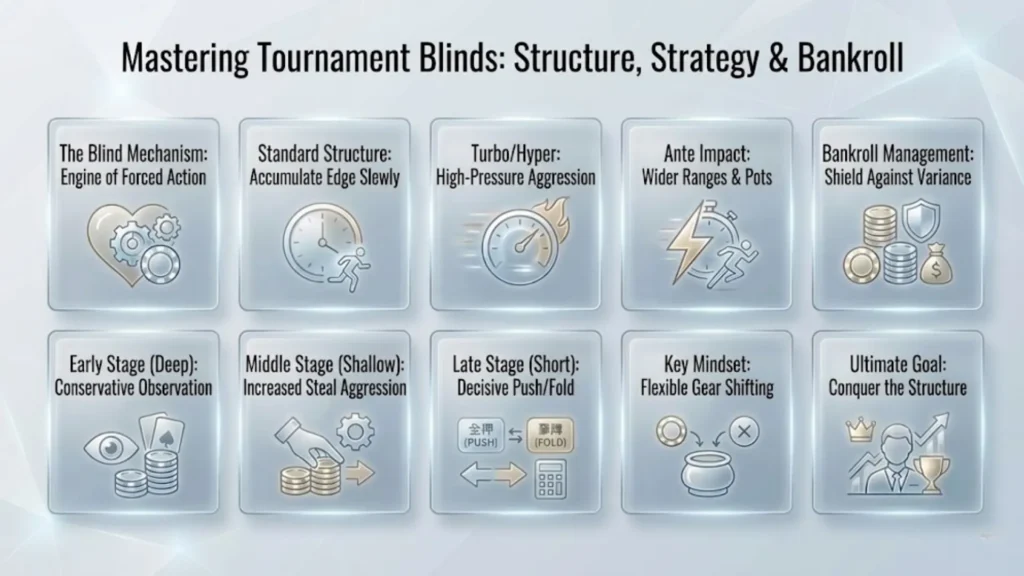
To win at poker tournaments, you must respect the blinds. They are not just an annoyance; they are the clock that dictates your survival.
Successful players adapt to the structure. They play patiently when the structure is slow and aggressively when the speed increases. They manage their bankroll to account for the variance of Turbo formats. Most importantly, they know that every chip saved or won keeps them alive for one more hand.
Study the structure, adjust your aggression, and you will find yourself navigating deep runs with far more consistency.