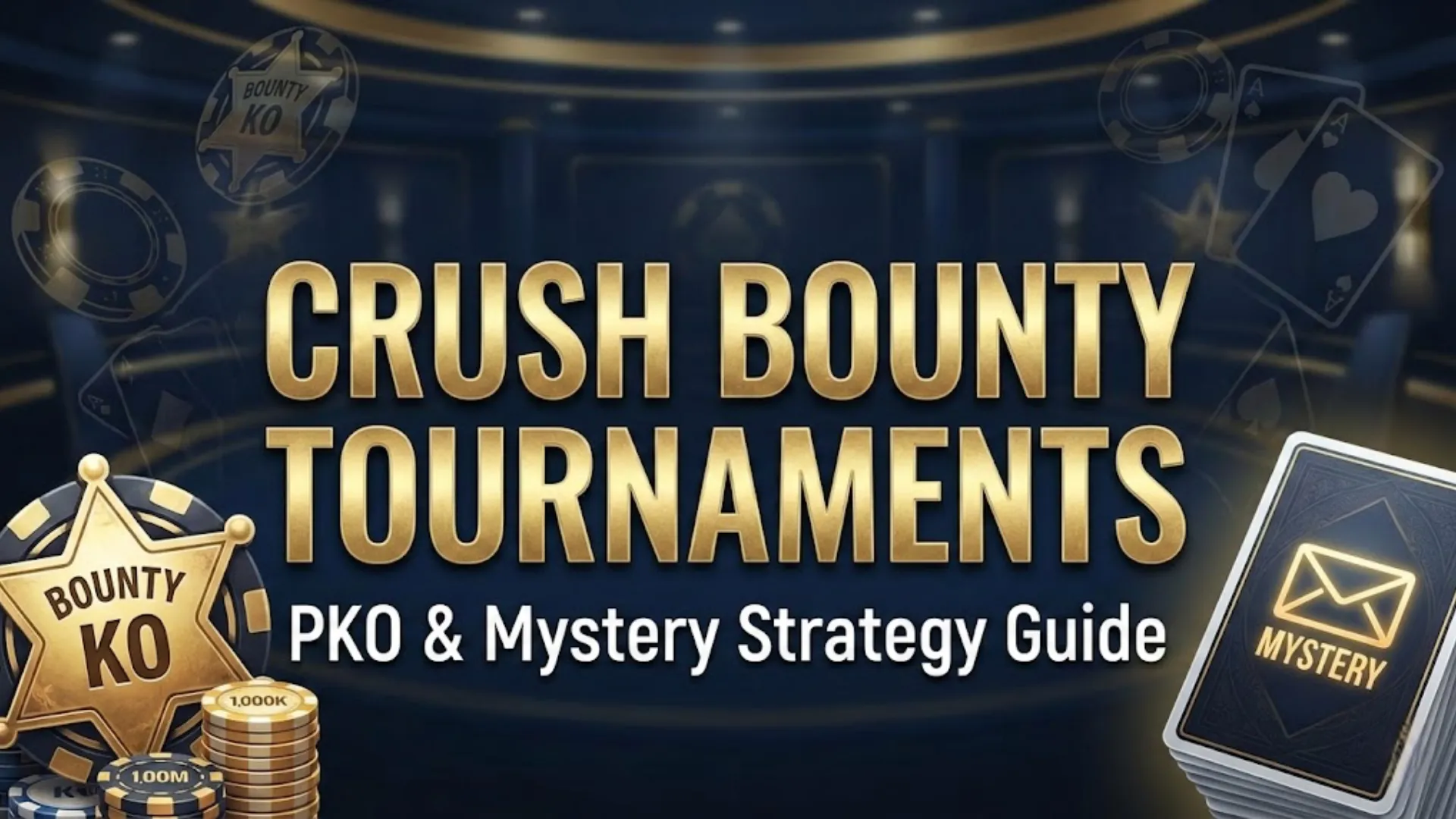
The Bounty Hunter’s Guide: How to Crush PKO and Mystery Tournaments
For a long time, tournament poker was framed as a pure survival game: protect your stack, make the money, and ladder up while others bust. The explosion of bounty formats—especially PKO and mystery bounty events—has replaced that one-dimensional goal with a constant trade-off between survival and hunting.
In these formats, a portion of the buy-in is carved out for bounties, creating immediate payouts every time a player is eliminated and fundamentally changing pot odds, risk profiles, and optimal aggression levels. Treating a bounty event like a regular freezeout is no longer an innocent mistake; it is a structural leak that leaves money on the table in almost every marginal spot.
Understanding the Bounty Landscape
In a classic freezeout, 100% of the buy-in goes into a single prize pool that pays out according to the final finishing positions. Bounty tournaments split this structure: a typical configuration sends roughly half of each buy-in into the regular prize pool and the other half into a separate bounty pool that sits on players’ heads throughout the event.
This split means you are effectively playing two overlapping games at once: a long-term contest for final-table payouts and a short-term hunt for immediate cash every time you bust someone. Strong bounty players constantly weigh both streams of value and are willing to take slightly thinner spots when a bounty pushes the total equity of a decision into profitable territory.
The Three Variants You Must Know
Not all bounty formats play the same. Understanding which variant you are in is crucial, because it dictates how much weight to give the bounty relative to chip EV at each stage of the event.
1. Standard Knockout (KO)
- Each player has a fixed cash bounty that does not change over the entire tournament.
- Because that fixed amount is a large percentage of the buy-in early and a small percentage late, the bounty has maximum influence on decisions in the early levels and fades in relevance near the final table.
- Practical takeaway: early-stage aggression to chase bounties can be very profitable, while in late stages you revert closer to standard ICM-aware strategy.
2. Progressive Knockout (PKO)
- Common online structures split the buy-in so that half goes to the main prize pool and half becomes a starting bounty on each player, with half of any collected bounty paid in cash and half added to the winner’s own head.
- As the tournament progresses and players accumulate knockouts, individual bounties can balloon to several times the starting amount, making those players extremely valuable targets in mid and late stages.
- Practical takeaway: early on, bounties are modest but still meaningful; deep in the event, busting a big bounty can be worth more immediate money than a mid-level finishing place, so you widen calling ranges aggressively when you cover those players.
3. Mystery Bounty
- These events typically have an initial “survival phase” that plays like a standard tournament with no bounties paid, followed by a final phase where each knockout earns a mystery prize drawn from a pre-defined pool.
- Most of the sealed prizes are relatively small, but a few outsized bounties can exceed even the first-place payout, which adds a lottery-like layer on top of standard tournament incentives.
- Practical takeaway: before the bounty phase, focus on accumulating chips; once bounties go live, recalibrate your risk tolerance based on average bounty value and stack distribution at your table.
The Math of Aggression: Converting Bounties to Chips
To play bounty formats well, it is necessary to think beyond raw chip counts and translate the cash value of a bounty into an equivalent amount of tournament chips. A common rule of thumb in 50/50 PKO structures is that a single starting bounty is worth roughly one-third of a starting stack in chip-equity terms, which is close to the 30% guideline used by many regulars.
Consider a spot where blinds are 1,000/2,000, an opponent shoves 20,000, and you are deciding whether to call. In a regular tournament, you might need around mid-40% equity against their range to justify a call when comparing your 20,000 risk to the total pot you can win. If you add the converted chip value of that player’s bounty to the pot in a PKO, the reward side of the equation grows, lowering the minimum equity you need by several percentage points and turning hands like K‑10 offsuit or small pairs from clear folds into profitable calls.
The exact numbers depend on the specific payout structure and how much of the buy-in funds the bounty pool, but the core principle holds across formats: when you can actually win the bounty, the “true” pot is bigger than the chips in the middle, so your calling thresholds against shoves should be noticeably wider than in a normal freezeout.
Critical Strategy Adjustments
Bounty formats reward players who understand how stack sizes interact with bounty availability. Three recurring situations—covering opponents, bullying as the chip leader, and playing with a large bounty on your own head—call for deliberate strategic shifts compared to standard MTT play.
1. The Power of “Covering”
- You only win a bounty if you have an equal or larger stack than the opponent when the hand starts; if they cover you, they can bust you and claim your bounty, but you cannot win theirs in that pot.
- This asymmetry means you should prioritize confrontations where you cover opponents with juicy bounties and be more conservative in marginal spots against players who cover you, because you are taking on full bust-out risk without the upside of collecting their head prize.
2. Bullying as the Chip Leader
- When you have the table’s biggest stack in a bounty event, especially a PKO, your ability to eliminate almost anyone gives you leverage that goes beyond chip count alone.
- Shorter stacks know you can knock them out and get paid immediately, which increases the psychological and mathematical pressure on them; as a result, you can profitably open wider, attack blinds more often, and call their shoves with slightly weaker hands than normal because the bounty boosts your effective pot odds.
3. Playing as the Target
- Once your own bounty grows large—either in a PKO or after surviving into the bounty phase of a mystery event—you become a magnet for action, and opponents may justify very loose calls against your shoves.
- In that state, bluff frequency should drop and value betting should become your default mode, because you can assume your all-ins and big bets will be called more often than in a standard tournament by players chasing your oversized bounty.
From Survivor to Hunter: Rethinking Your Role in Bounty MTTs
Bounty, PKO, and mystery formats replace the old “just survive” mentality with a more nuanced objective that blends chip accumulation, payout ladders, and immediate cash rewards for knockouts. Winning in these games requires treating bounties as part of the pot, recognizing when their value justifies lighter calls, and adjusting your ranges dynamically as your stack size and bounty status change.
By internalizing how each variant splits the prize pool, learning simple bounty-to-chip conversion rules, and leaning into your edge when you cover opponents or hold the chip lead, you turn high-variance chaos into structured opportunity. That shift—from playing as prey to playing as a deliberate hunter—is what separates true bounty specialists from everyone else clicking the same “Register” button.