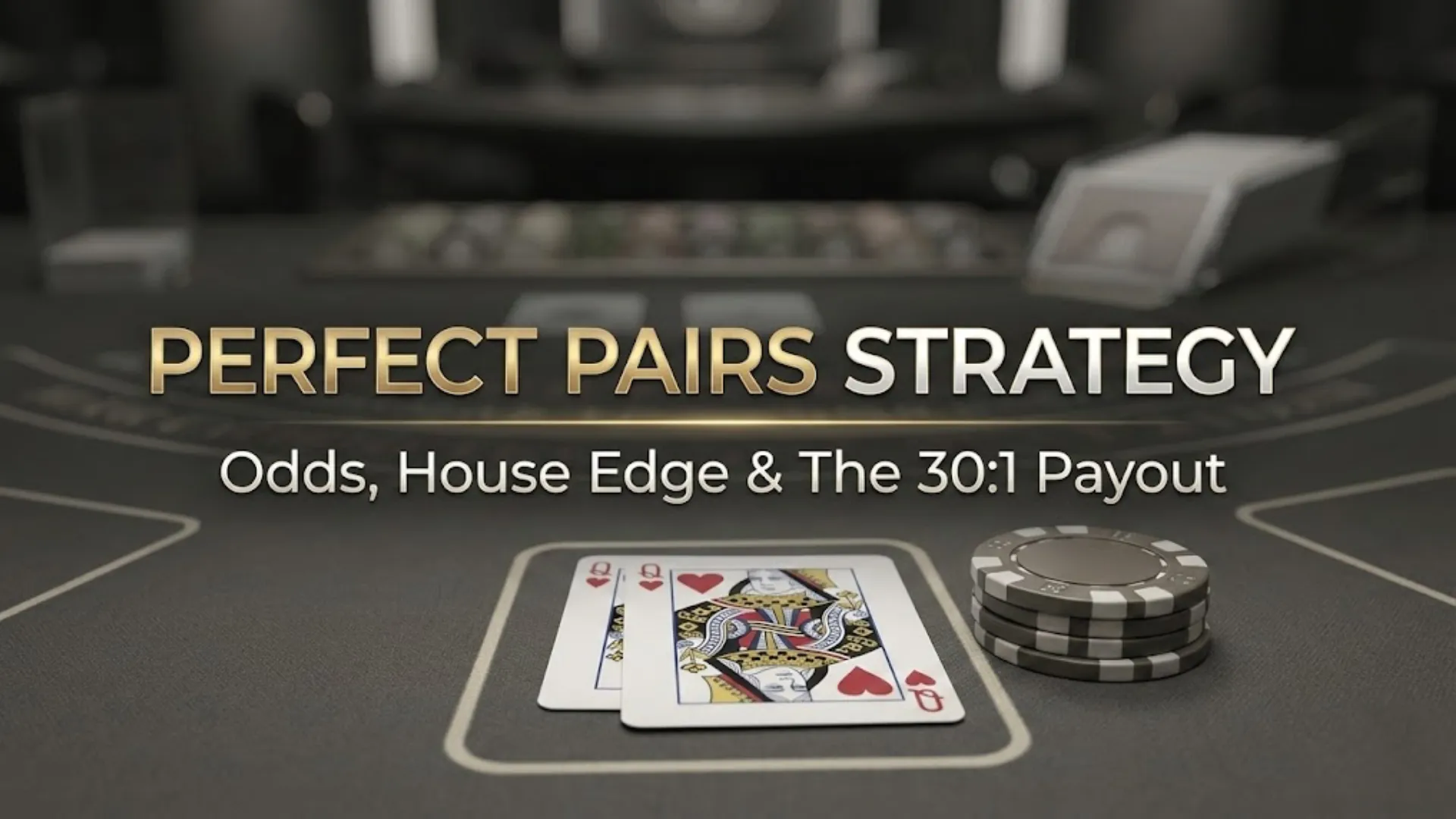
The Ultimate Guide to Perfect Pairs: Blackjack’s Most Thrilling Side Bet
Blackjack is typically a game of strategy, grinding down the house edge with perfect decisions. But for players chasing the adrenaline of a high-return payout without learning complex poker rules, the Perfect Pairs side bet is the go-to choice.
While the main game offers standard 1:1 or 3:2 payouts, Perfect Pairs opens the door to returns as high as 30:1 in a single second. This guide breaks down the mechanics, the exact mathematics behind the odds, and the reality of the house edge.
Understanding the Perfect Pairs Wager
The Perfect Pairs bet is an independent wager. It does not affect your main blackjack hand, nor does it care about the dealer’s cards. It focuses entirely on the first two cards dealt to you.
The premise is simple: you are betting that your initial two cards will be a pair (e.g., two Kings, two Fives, etc.). However, not all pairs are created equal. The payout scales based on the precision of the match—specifically regarding color and suit.
How to Place the Bet + Payout Hierarchy
- The Ante: Place your standard blackjack wager in the main circle.
- The Side Bet: Place chips in the designated “Perfect Pairs” area (usually a smaller circle or logo near your betting box).
- The Settlement: Once cards are dealt, the dealer settles side bets immediately. If you have a pair, you are paid according to the pay table. If not, the bet is collected.
- The Game Continues: The hand proceeds as normal (hit, stand, double, etc.).
| Hand Type | Definition | Example | Typical Payout |
|---|---|---|---|
| Perfect Pair | Identical Rank AND Suit | J♣ + J♣ | 30 to 1 |
| Colored Pair | Same Rank AND Color (Diff Suit) | K♦ + K♥ | 10 to 1 |
| Mixed Pair | Same Rank, Different Color | 7♠ + 7♥ | 5 to 1 |
The Mathematics: Exact Odds (8-Deck Shoe)
When your first card is dealt, there are 415 cards remaining in the shoe. Here is the breakdown:
| Hand Type | Matching Cards Left | Probability | Frequency |
|---|---|---|---|
| Mixed Pair | 16 cards | 16 / 415 ≈ 3.86% | 1 in 26 hands |
| Colored Pair | 8 cards | 8 / 415 ≈ 1.93% | 1 in 52 hands |
| Perfect Pair | 7 cards | 7 / 415 ≈ 1.69% | 1 in 59 hands |
House Edge: 10.85% (RTP 89.15%)
By combining the probabilities and the payouts, we can determine the “Return to Player” (RTP).
- Total RTP: Approximately 89.15%
- House Edge: Approximately 10.85%
The Bottom Line: For every $100 wagered purely on Perfect Pairs over the long run, the casino keeps about $10.85. Compare this to standard blackjack strategy (where the house edge is ~0.5%), and it is clear this is a high-volatility gamble, not a sustainable profit strategy.
Deck Count Matters: 6 vs 8 Decks
Savvy players check the number of decks before playing. The house edge on Perfect Pairs fluctuates based on the shoe size because the density of “perfect” matches changes.
- 8 Decks: Lower volatility, slightly easier to hit a Perfect Pair (more duplicate cards available).
- 6 Decks: In a 6-deck game, there are fewer identical cards (only 5 matches left for a Perfect Pair after the first card). This actually increases the house edge significantly.
Pro Tip: If you enjoy this side bet, you are mathematically better off playing it at an 8-deck table rather than a 6-deck table.
Perfect Pairs vs 21+3: Which is Better?
- Play Perfect Pairs if: You prefer simple mechanics and high volatility. You want a “jackpot” feeling with the 30:1 potential.
- Play 21+3 if: You want a slightly lower house edge (usually around 3-4% depending on the pay table) and more frequent, smaller wins. 21+3 uses poker hand rankings (flush, straight, trips) using your two cards and the dealer’s up-card.
Strategic Verdict + Bankroll Rules
Perfect Pairs is an “entertainment fee.” It adds excitement to the grind of standard blackjack and offers the rare moment of a 30x payout.
To maximize your experience:
- Bankroll Management: Never bet more than 5-10% of your main hand wager on the side bet.
- Check the Table: Verify the payouts are 30-10-5. Some tables offer “Table B” payouts (25-12-6), which changes the math slightly.
- Know the Cost: Accept that the house edge is over 10%. Play it for the thrill, not for the investment.


完全攻略:從發牌規則到夢幻天地,一篇讀懂_EN-300x169.webp)
,新手又該如何克服它?_EN-300x169.webp)