
It is a story every grinder knows too well. You are the shark at your local home game. You consistently cash out at the casino. But the moment you fire up an online poker client, that winning edge evaporates. You deposit, you grind, and you bust.
The game is still Texas Hold’em. The rules have not changed. You are playing from the comfort of your own home without opponents staring you down. So why is the outcome so different?
While the mechanics are identical, the online arena is a different beast entirely. Based on insights from industry experts, here are the ten critical adjustments you must make to successfully transfer your live poker skills to the virtual felt.
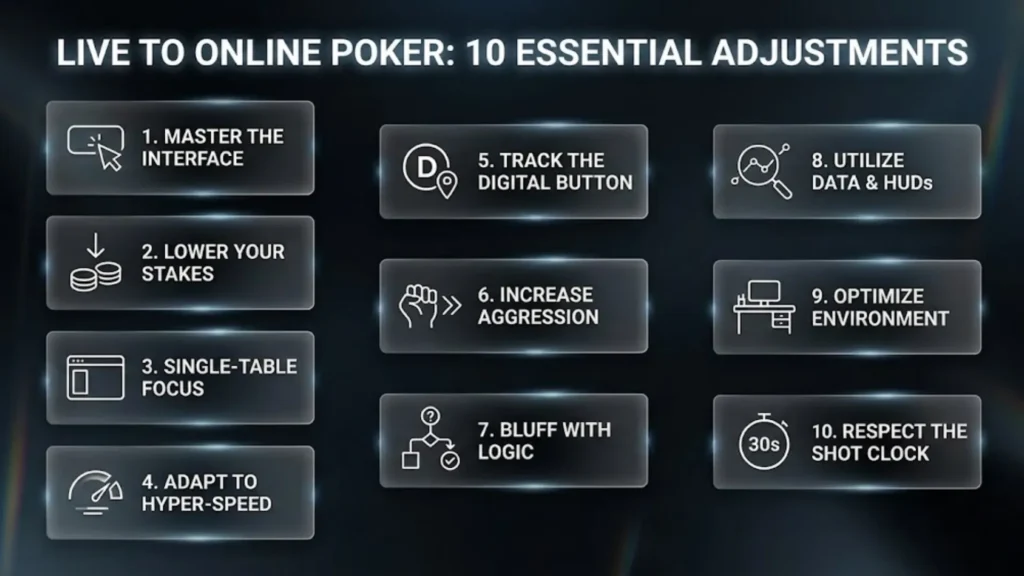
Master the Software Before You Risk a Cent
In live poker, you handle physical chips and verbalize your actions. Online poker is purely mechanical. A surprising number of losses for new online players come from “misclicks” or simply not understanding the interface.
Do not learn on the fly. Sit out for a few orbits when you first join a table. Locate the fold, call, and raise buttons so you do not hit the wrong one by accident. Learn how to use the bet slider and chat features. Spending a few minutes to build this muscle memory can save you from a costly technical error in a big pot.
Drop Down to Your Financial Comfort Zone
Bankroll management is vital in live games, but it is absolute law online. Just because you play $1/$2 or $2/$5 at a casino does not mean you should play those same stakes online.
The average skill level in online pools is significantly higher than in live games. A good rule of thumb is to start at a lower limit than you are used to. Playing within a strict comfort zone allows you to make decisions based on math and logic rather than the fear of losing money. You can always move up once you are crushing the lower stakes.
The Power of Focus: Play One Table
Online poker offers the temptation to play twenty tables at once. For a player transitioning from live poker, this is a trap. The influx of data will quickly overwhelm you.
Resist the urge to multi-table until you are winning consistently. Stick to a single table. This allows you to pay attention to betting patterns and opponent tendencies with the same depth you would use in a live tournament. Treat that one table with the same respect you would give a live game.
Adjust to the Hyper-Speed of Online Play
The pace of play is the most shocking difference for live veterans. A live dealer might pitch 25 to 30 hands per hour. Online, that number jumps to between 75 and 100 hands per hour.
This means you will see bad cards and “coolers” three times as often. It is easy to mistake this natural variance for a bad run of luck. Do not let the speed bore you into playing trash hands just to see a flop. Discipline is your best defense against the rapid pace.
Respect the Button in a 2D World
Position is king in Hold’em. At a live table, the dealer button is a physical object you can see clearly. On a screen, it is just a small graphic that is easy to lose track of.
Always verify your position relative to the button before you act. Mistaking early position for late position is a massive leak. Make it a habit to check the button location every single hand to ensure you are not opening with weak holdings in dangerous spots.
Ramp Up the Aggression
Live players often rely on physical reads to win pots. Online, you cannot see your opponent, so you must let your chips do the talking.
Online play generally rewards higher aggression. Since players are clicking buttons rather than tossing physical cash, they tend to be looser and more willing to gamble. You need to punish this. Defend your blinds aggressively and value bet your strong hands relentlessly. In the absence of physical tells, aggression is your primary tool to control the pot.
Tell a Logical Story When Bluffing
Bluffing online is about logic, not acting. You cannot speech-play your opponent or use charisma to get a fold. You only have your bet sizing and history.
For a bluff to work online, your betting line must tell a consistent story. Smart online players analyze your betting history to see if it makes sense. If your actions from pre-flop to river align with the strong hand you are representing, you will get folds. If your story has holes, you will get looked up.
Leverage Data and Analysis Tools
One massive advantage of online poker is that every single action is recorded. Live hands are often forgotten, but online hands are data.
Use this to your advantage. Tools like GGPoker’s PokerCraft allow you to track your journey and review hands objectively. For deeper study, advanced analytics programs like ‘Ask Fedor’ can analyze your decisions to see if you played optimally. Reviewing your session after the grind is the fastest way to plug leaks in your game.
Treat Your Setup Like a Workplace
Your environment dictates your focus. A casino is designed to keep you engaged. At home, you are surrounded by distractions.
You cannot play your A-game while watching Netflix or checking emails. Create a distraction-free zone. Have water and snacks ready before you sit down. Handle your bathroom breaks during the synchronized 5-minute breaks. If you treat the game with professional respect, your results will reflect that.
Don’t Let the Shot Clock Tilt You
Online poker uses a shot clock, typically 30 seconds or less. This adds a layer of artificial pressure that does not exist in most cash games.
Do not let the countdown force you into a panic. Rushing leads to mistakes. If you are facing a tough decision and the time bank is running out, folding is usually the better option than making a frantic call. Patience is profitable. It is better to wait for a better spot than to dust off your stack because you felt rushed.