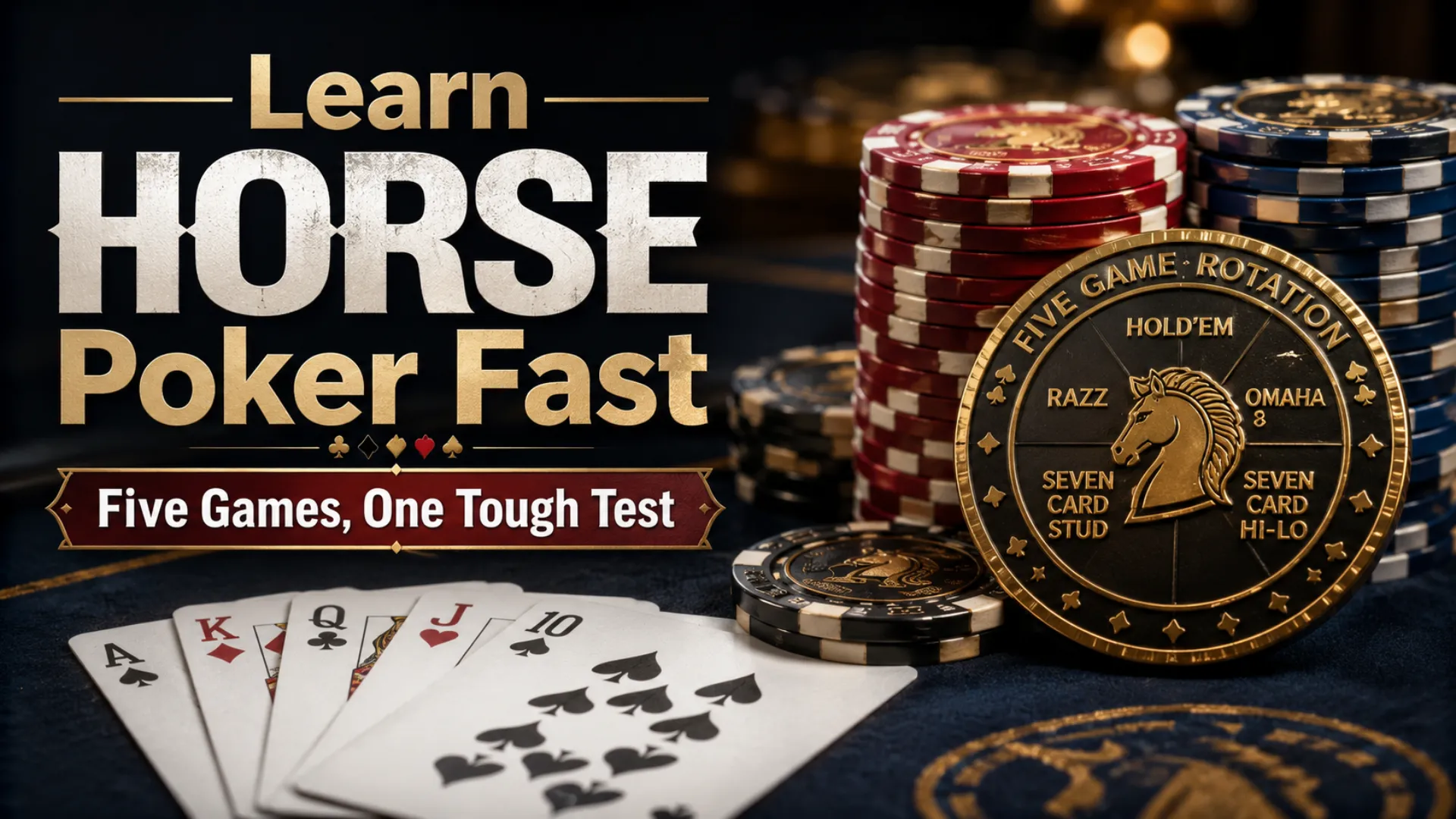
HORSE is poker’s classic mixed-game test. The rotation runs in a fixed order: Limit Hold’em, Omaha Hi-Lo, Razz, Seven-Card Stud, and Seven-Card Stud Hi-Lo Eight-or-Better. In most formats, each game is played for one orbit before the table moves to the next. Winning at HORSE requires more than knowing five rule sets; you need to change gears quickly as the game changes.
HORSE is a fixed mixed-game rotation, not a pure dealer’s-choice game. The five variants are usually played with fixed-limit betting, so hand selection, live-card awareness, and thin value betting matter more than oversized bluffs. The format appears in high-stakes cash games and major mixed-game tournaments, including the WSOP $10,000 H.O.R.S.E. Championship. Strong HORSE players profit by finding opponents who are comfortable in one game but exposed in the others.
The Five Games of HORSE
| Letter | Game | Board / Cards | Pot Type |
|---|---|---|---|
| H | Texas Hold’em | 2 hole + 5 community | High only |
| O | Omaha Hi-Lo (8 or Better) | 4 hole + 5 community | Split Hi/Lo |
| R | Razz | 7 cards dealt, no board | Low only |
| S | Seven-Card Stud | 7 cards dealt, no board | High only |
| E | Seven-Card Stud Hi-Lo (8 or Better) | 7 cards dealt, no board | Split Hi/Lo |
Hold’em in HORSE
The Hold’em round is fixed-limit, so it plays very differently from no-limit Hold’em. You cannot shove to deny equity or size up enough to make a draw pay the wrong price. Position, hand selection, thin value bets, and disciplined pot-odds decisions matter more than big-pressure bluffing.
Fixed-Limit Adjustments
In fixed-limit Hold’em, your bet size is capped. You cannot push opponents off draws with an oversized bet or hide strength through unusual sizing. Calls are cheaper, so multi-way pots appear often. Speculative hands still have a role in the right pot, but they lose much of the implied-odds upside they have in no-limit; top pair with a strong kicker and other made hands rise in relative value.
Core Principles Hold
Position, hand selection, opponent reading, and pot-odds math still carry over from no-limit. The edge comes from recognizing who stays competent after the Hold’em round ends. Many players handle H comfortably but lose clarity in Razz, Stud, or Stud 8. Take value in Hold’em, then widen your attack in their weaker rounds.
Omaha Hi-Lo in HORSE
Omaha Hi-Lo (O8) is usually the most complex HORSE game for beginners. You receive four hole cards and must use exactly two of them with exactly three community cards. The pot is split between the best high hand and the best qualifying low hand, which must use five different ranks of 8 or lower. A single player can scoop the pot by winning both halves.
The single most important concept in O8 is scooping: winning both the high half and the low half. Hands that can win only one side are vulnerable, especially in multi-way pots. A hand such as A-2-3-K with suited potential can make the nut low while still building a credible high hand. By contrast, a hand chasing only a medium high or a shared low can get quartered and lose money even when it technically wins part of the pot.
A-2 is the most powerful low combination. A-3 is the next tier. Without one of these, your low potential is much weaker. Avoid chasing marginal lows in O8 because sharing the low half with another player can leave you quartered, making weak lows unprofitable even in pots you partially win.
The wheel (A-2-3-4-5) is the nut low and also a straight for high. That makes it one of the clearest scoop patterns in O8. Hands with A-2 plus backup low cards, suitedness, or high-card strength deserve special attention. Low cards are valuable, but they are strongest when they work with an ace, avoid duplication, and give you more than one way to win.
Always check whether the board can support a qualifying low, meaning at least three board cards of different ranks are 8 or lower. If the board is made up only of high cards from 9 through K, no low is possible. The entire pot goes to the best high hand, and that hand plays like Omaha High for the moment. Adjust your aggression accordingly.
Razz Strategy
Razz is a lowball stud game where the lowest hand wins. Aces play low, and straights and flushes do not hurt your hand. The best hand is A-2-3-4-5, known as the wheel. The first two cards are dealt face-down and the third card, the door card, is dealt face-up. The highest exposed card at the start posts the bring-in.
Three Low Cards
The ideal start is three low cards, preferably 8 or lower and ideally including an ace. A-2-3 is the premium start, and A-2-4 is nearly as strong. Three cards 6 or lower are often worth completing when they are live. Hands built around 7s and 8s are playable but marginal. Pairs and 9-high starts should usually be folded unless the table gives you a clear steal spot.
Watch Up-Cards
In Razz and all Stud variants, exposed and folded cards matter because they cannot return to the deck. If the cards you need for your low hand are already visible in opponents’ up-cards, your hand is effectively dead and its value drops sharply. Before entering a pot, check how many of your key outs are still live.
Board Representation
If your door card is low (A, 2, or 3) while opponents show high cards, your visible board represents strength. Complete aggressively and keep pressure on fourth and fifth card when your board stays clean. In fixed-limit Razz, these semi-bluffs with strong visible cards are a major source of profit.
Seven-Card Stud Strategy
Seven-Card Stud starts with three cards: two down and one up. Players then receive three more up-cards and a final down-card. There is no community board. The dominant skill is table reading, which means tracking which cards are still live and which cards are already dead.
| Starting Hand Type | Strength | Key Condition |
|---|---|---|
| Three of a kind (rolled up) | Excellent | Almost always complete and raise |
| High pair (AA, KK, QQ) | Strong | Kicker matters; fold if pair is dead |
| Three to a flush (suited) | Good | Fold if 3+ of your suit are dead |
| Three to a straight (connected) | Marginal | Only play with live outs |
| Low pair (22-66) | Weak | Fold unless concealed; look for sets |
| High card, unconnected | Fold | No redeeming draw or pair potential |
The most important discipline in Stud is folding when your draw goes dead. A flush draw loses most of its value when three or more cards of your suit are already visible in opponents’ up-cards. Many players keep chasing because they feel pot committed. That leak is one of the easiest to punish at HORSE tables.
Stud Hi-Lo Eight-or-Better Strategy
Stud 8, the E in HORSE, combines Stud’s card-tracking with O8’s scooping concept. Like O8, a qualifying low requires five different ranks of 8 or lower. Like Stud, there is no community board, so every read comes from your opponents’ exposed up-cards.
- Premium starts: Three low cards including an ace, such as A-2-X or A-3-X with X usually 6 or lower. These hands can make a strong low while still developing pair, two-pair, or straight equity for the high half.
- Dangerous traps: Three to a high flush or high straight. In Stud 8, high-only hands can win only half the pot and become expensive when low boards keep applying pressure.
- Reading the board: Track opponents’ low up-cards carefully. If multiple players show coordinated low boards, the pot is likely to split, so reduce investment in high-only hands.
- Stealing with low boards: When your visible cards are low and opponents show high cards, you can credibly represent a strong low draw or made low and build pressure before your hand is fully defined.
Cross-Game Meta Strategy
Tighten in Your Weak Game
Every HORSE player has a weakest game. Identify yours honestly. In that round, tighten your starting hand requirements, reduce bluffing frequency, and play simple, technically sound poker. Losing less in your weak game matters as much as winning more in your strong game.
Watch the First Hands After Each Switch
When the game switches, distracted players sometimes keep using the previous game’s logic. A player who treats the first Razz hand like Hold’em, or who misreads the low qualifier in Omaha 8, is showing you a real leak. These transition mistakes show up most often in the first hand or two after the change.
Fixed-limit HORSE usually has lower one-hand all-in volatility than no-limit Hold’em, but long mixed-game sessions still swing. For live HORSE cash games, a practical baseline is at least 300 big bets. For tournaments, use standard MTT bankroll discipline, often 50 to 100 buy-ins at your regular stakes depending on field size and your edge.
Most Hold’em players moving into HORSE struggle most with Razz and Stud 8. Prioritize low-hand qualification, live-card tracking, and starting hand standards for the Stud variants. These rounds are where recreational players often make their biggest technical mistakes.
In HORSE cash games, table selection can matter even more than in Hold’em because skill gaps across five games are wider. A player who is strong in Hold’em but weak in Razz and Stud 8 becomes vulnerable for two of the five rounds. Look for tables where your strongest games line up with other players’ weakest ones.
Frequently Asked Questions
What is the order of games in HORSE? +
The rotation is Hold’em, Omaha Hi-Lo (Eight-or-Better), Razz, Seven-Card Stud, and Seven-Card Stud Hi-Lo Eight-or-Better. In many live and online formats, each game runs for one orbit before the sequence returns to Hold’em.
What does “Eight-or-Better” mean in Omaha and Stud? +
Eight-or-Better means a qualifying low hand must contain five different ranks of 8 or lower, with aces counting low. If no player makes a qualifying low, the entire pot goes to the best high hand. A low that uses a 9 or 10 does not qualify for the low half.
Is HORSE harder to beat than Hold’em? +
HORSE is harder for most players because it requires competence across five games. That difficulty also creates edge. A well-rounded player can gain against Hold’em specialists who lose accuracy in Razz, Stud, Omaha Hi-Lo, or Stud 8.
What is a “quartered” pot in Omaha Hi-Lo? +
When two players tie for the same half of the pot, each receives one quarter of the total pot instead of one half. This often happens on the low side when two players make the same low. If you invest heavily and get quartered, you may win your direction but still lose money overall. That is why weak or duplicate lows are dangerous.
Can I learn HORSE without knowing all five games first? +
You can start with basic knowledge of all five games, but your weakest rounds will cost you. Before sitting down, learn the key rules and starting hand standards for each variant. If you come from Hold’em, prioritize Razz and Stud 8 first. Low-stakes HORSE games are the safest place to build experience across the full rotation.
Looking for the right platform?
Our team can help you compare trusted online poker platforms and find suitable sign-up offers. Get in touch.
This guide is for educational purposes only. Online poker involves financial risk and is intended for adults aged 18 and over. Play responsibly, stay within your bankroll limits, and follow the laws in your jurisdiction.