
In standard poker, a royal flush is the strongest hand and high card is the weakest. Any hand higher on the ranking beats a hand below it at showdown.
Royal Flush → Straight Flush → Four of a Kind → Full House → Flush → Straight → Three of a Kind → Two Pair → One Pair → High Card
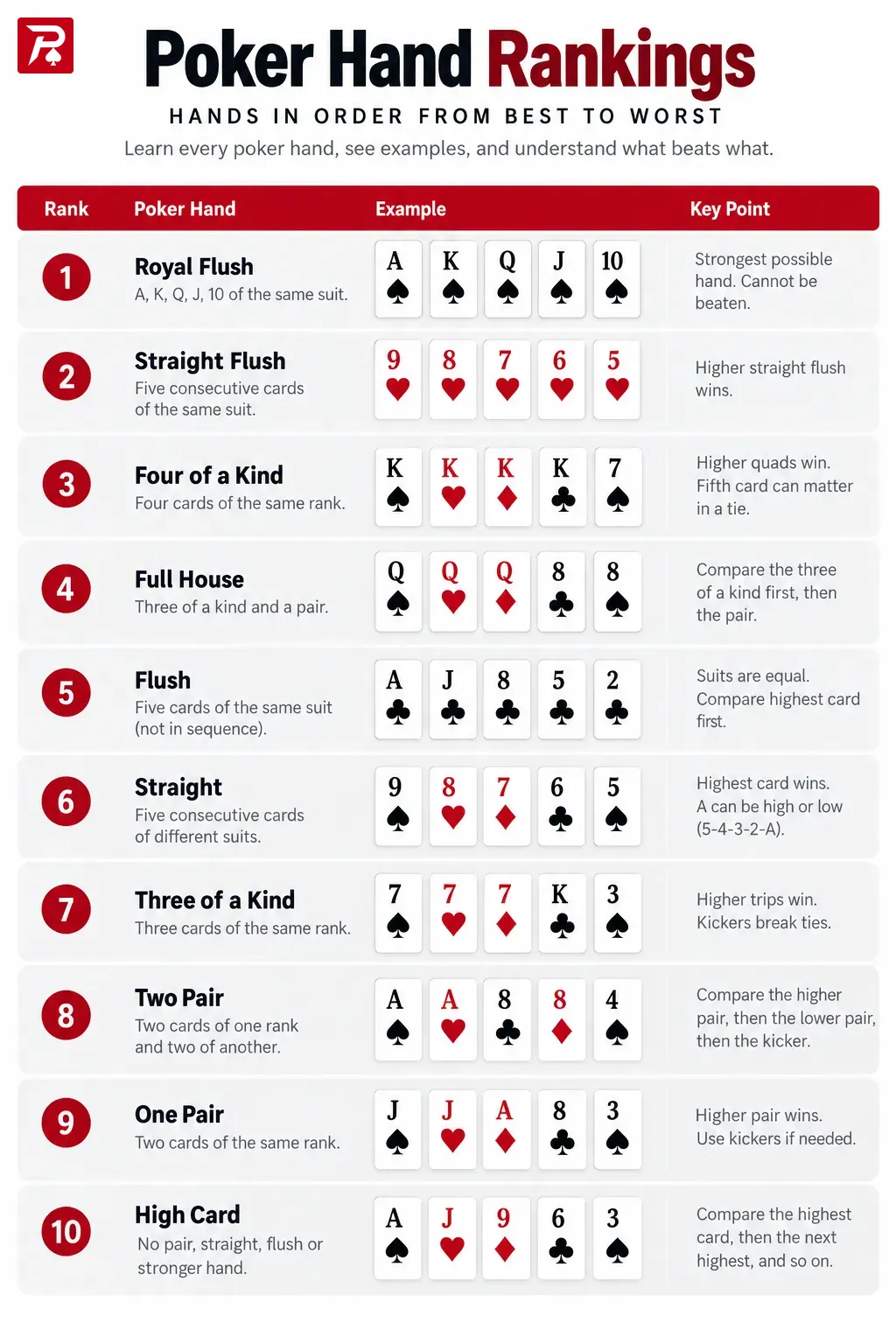
Poker Hand Rankings at a Glance
Start with the hand category. When two players make the same category, card ranks and kickers decide the winner.
A royal flush is traditionally shown separately in poker hand charts, although technically it is the highest possible straight flush.
Poker Hands From Highest to Lowest
The ranking itself is simple. The details below explain how each hand is made and what settles a tie.
Royal Flush
A royal flush is an ace-high straight with all five cards in the same suit. It is the strongest possible standard poker hand.
Suits are equal. A royal flush in spades does not outrank one in hearts. If all five cards appear on the board in Texas Hold’em, the pot is split.
Straight Flush
Five consecutive cards of the same suit make a straight flush. The highest card decides between two straight flushes.
A ten-high straight flush beats a nine-high straight flush. The lowest possible version is 5-4-3-2-A.
Four of a Kind
Four of a kind, usually called quads, means holding all four cards of the same rank.
Higher quads win. If both players share the same four cards on the board, the fifth card can settle the hand.
Full House
A full house combines three cards of one rank and two cards of another. Compare the three-of-a-kind portion first.
K-K-K-2-2 beats Q-Q-Q-A-A. If the trips match, the pair decides the winner.
Flush
A flush contains five cards of the same suit without forming a straight. Suit itself has no ranking.
Compare the highest card first. A-J-8-5-2 beats A-10-9-7-4 because the jack beats the ten.
Straight
A straight contains five consecutive ranks. The highest card determines which straight wins.
A-K-Q-J-10 is the highest straight; 5-4-3-2-A is the lowest. Q-K-A-2-3 does not count.
Three of a Kind
Three cards of the same rank plus two unmatched cards make three of a kind.
Set and trips describe different ways to make the same hand category; neither ranks higher than the other.
Two Pair
Two pair contains two cards of one rank and two cards of another. Compare the higher pair first.
If both pairs are identical, the kicker matters: A-A-8-8-K beats A-A-8-8-Q.
One Pair
One pair means two cards of the same rank. Higher pairs beat lower pairs.
If the pair is identical, compare the remaining cards from highest to lowest.
High Card
High card applies when no pair, straight, flush or stronger hand is made.
Compare the highest card first and work downward until the tie is broken.
How Your Best Five Cards Are Chosen
In Texas Hold’em, seven cards are available to you, but only the best five form your final hand.
What Does “Playing the Board” Mean?
If the community cards already form the best possible five-card hand, your hole cards do not improve it.
The board already makes A-K-Q-J-10. Both players use the same five cards, so the pot is split.
How Poker Ties Are Broken
When the category is the same, compare the part of the hand that gives it its rank, then move to kickers when necessary.
Both players have K-K-A. Player A wins because the queen kicker beats Player B’s jack.
Two Rules That Often Cause Confusion
Do suits break ties?
No. Spades, hearts, diamonds and clubs have equal value in standard poker hand rankings.
Identical five-card hands split the pot rather than using suit as a tie-breaker.
Can an ace be high or low?
Yes. A-K-Q-J-10 is the highest straight, while 5-4-3-2-A is the lowest.
The ace cannot wrap around the deck, so Q-K-A-2-3 is not a straight.
Poker Hand Rankings vs Starting Hands
The two terms sound similar but describe different stages of the game.
Poker hand rankings compare completed five-card hands, such as a flush, straight or full house.
Starting hands are the two cards dealt before the flop in Texas Hold’em, such as A-A, K-K or A-K suited.
Do These Rankings Apply to Every Poker Game?
They apply to standard high-hand games such as Texas Hold’em and conventional Pot-Limit Omaha.
Some variants differ. Short Deck can change the ranking of certain hands, while lowball games and Razz reward lower hands instead of higher ones.