
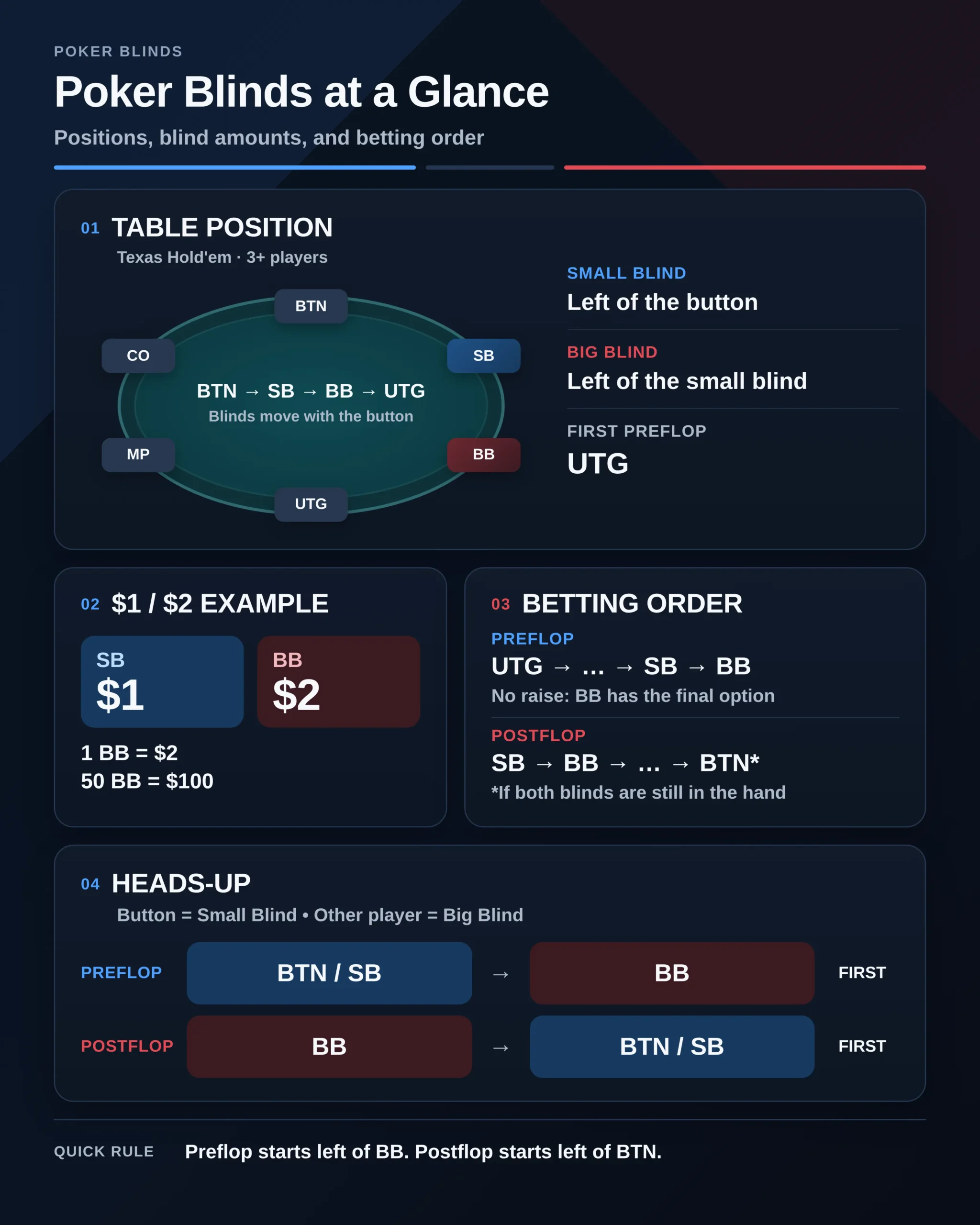
Poker blinds are forced bets posted before the cards are dealt. With three or more players, the seat to the left of the dealer button posts the small blind, and the next seat posts the big blind. The blinds put chips in the pot before anyone chooses to bet.
Dealer Button → Small Blind → Big Blind → First Player to Act Preflop
What are blinds in poker?
The small blind and big blind are mandatory bets posted at the start of every hand. As the dealer button moves around the table, the blind positions move with it.
Small Blind
With three or more players, the small blind sits immediately to the left of the dealer button.
It is usually the smaller of the two blinds and is often half the big blind, although the exact structure varies by game.
Big Blind
The big blind sits immediately to the left of the small blind and posts the larger forced bet.
Preflop, players can call the current bet, raise, or fold when the action reaches them.
Small blind vs big blind: what’s the difference?
The main differences are the amount posted, where each player sits, and when each position acts.
Where are the blinds at the poker table?
With three or more players, the small blind is immediately to the left of the dealer button. The big blind is immediately to the left of the small blind.
Who acts first before the flop?
With three or more players, the player immediately to the left of the big blind acts first preflop. This position is commonly called Under the Gun, or UTG.
Action then moves clockwise around the table. The small blind acts near the end. If no one has raised by the time action reaches the big blind, the big blind can check or raise.
UTG acts first
Action moves clockwise
Small Blind acts near the end
Big Blind gets the final option if no one raises
Who acts first after the flop?
Once the flop is dealt, the order changes. The first active player to the left of the dealer button acts first.
If both blinds are still in the hand, the small blind acts before the big blind.
How much are the small blind and big blind?
Blind sizes depend on the stakes. At a typical $1/$2 cash table, the small blind is $1 and the big blind is $2.
The small blind is often half the big blind, but not every game uses that ratio. Check the posted blind structure for the table or tournament.
What does 1 BB mean in poker?
1 BB means one big blind. Players often describe stack sizes in big blinds instead of chips or cash because it makes different stakes easier to compare.
At the same table, a $100 stack equals 50 BB because $100 divided by the $2 big blind equals 50.
Does the blind count toward your bet?
Yes. Chips already posted as a blind count toward the amount you need to put in during the preflop betting round.
If the current bet is still $2, the small blind only needs to add $1 to call.
Why does poker use blinds?
Blinds put chips in the pot before voluntary betting begins and make sure every player contributes as the blind positions move around the table.
Create a pot
There are already chips worth competing for when the cards are dealt.
Keep the game moving
Players cannot wait indefinitely for premium hands without eventually posting chips.
Rotate the cost
As the button moves around the table, every player eventually takes a turn in the blinds.
Example: how blinds work in a $1/$2 game
Suppose six players are playing $1/$2 No-Limit Texas Hold’em. Before the cards are dealt, the small blind posts $1 and the big blind posts $2.
The player immediately to the left of the big blind acts first and can fold, call $2, or raise.
If everyone folds, the big blind wins the pot without seeing a flop. If someone calls or raises, the hand continues.
How do blinds work heads-up?
With only two players, the blind positions and betting order change.
Button posts the small blind
The player on the dealer button also posts the small blind.
Other player posts the big blind
The player without the button posts the big blind.
Button acts first preflop
The button is also the small blind, so that player acts first before the flop.
Big Blind acts first postflop
After the flop, the big blind acts first and the button acts last.
How do blinds work in poker tournaments?
Tournament blinds increase as the event progresses. Each blind level usually lasts for a set amount of time, although some formats use a set number of hands instead.
A tournament might move from 100/200 blinds to 200/400, then continue upward according to the event’s structure. As the blinds rise, the same chip stack becomes worth fewer big blinds.
Blinds vs antes: what’s the difference?
Blinds and antes are both forced contributions, but they are collected differently.
Posted by specific positions, usually the small blind and big blind.
An ante is another forced contribution. Depending on the format, every player may post one, or the big blind may post a big blind ante for the table.
A game can use blinds without antes. Many tournaments introduce antes after the early levels to increase the amount in the pot before the hand starts.
Common questions about poker blinds
Does the big blind have to bet again?
No, not automatically. The big blind has already posted chips before the cards are dealt.
If no one raises, the big blind can check or raise. If someone has raised, the big blind must respond to the current bet by folding, calling, or raising.
Can the small blind fold?
Yes. Posting the small blind does not force the player to continue in the hand.
If the player does not want to match the current bet, they can fold and give up the chips already posted.
Does the big blind always act last?
No. If no one raises preflop, the big blind gets the final option in that betting round.
After the flop, betting starts with the first active player to the left of the dealer button.
Is the small blind always half the big blind?
No. Half is common, but the exact blind sizes depend on the stakes and structure of the game.
Poker blinds: quick reference
Smaller forced blind
Larger forced blind
Action starts left of the big blind
Action starts left of the button