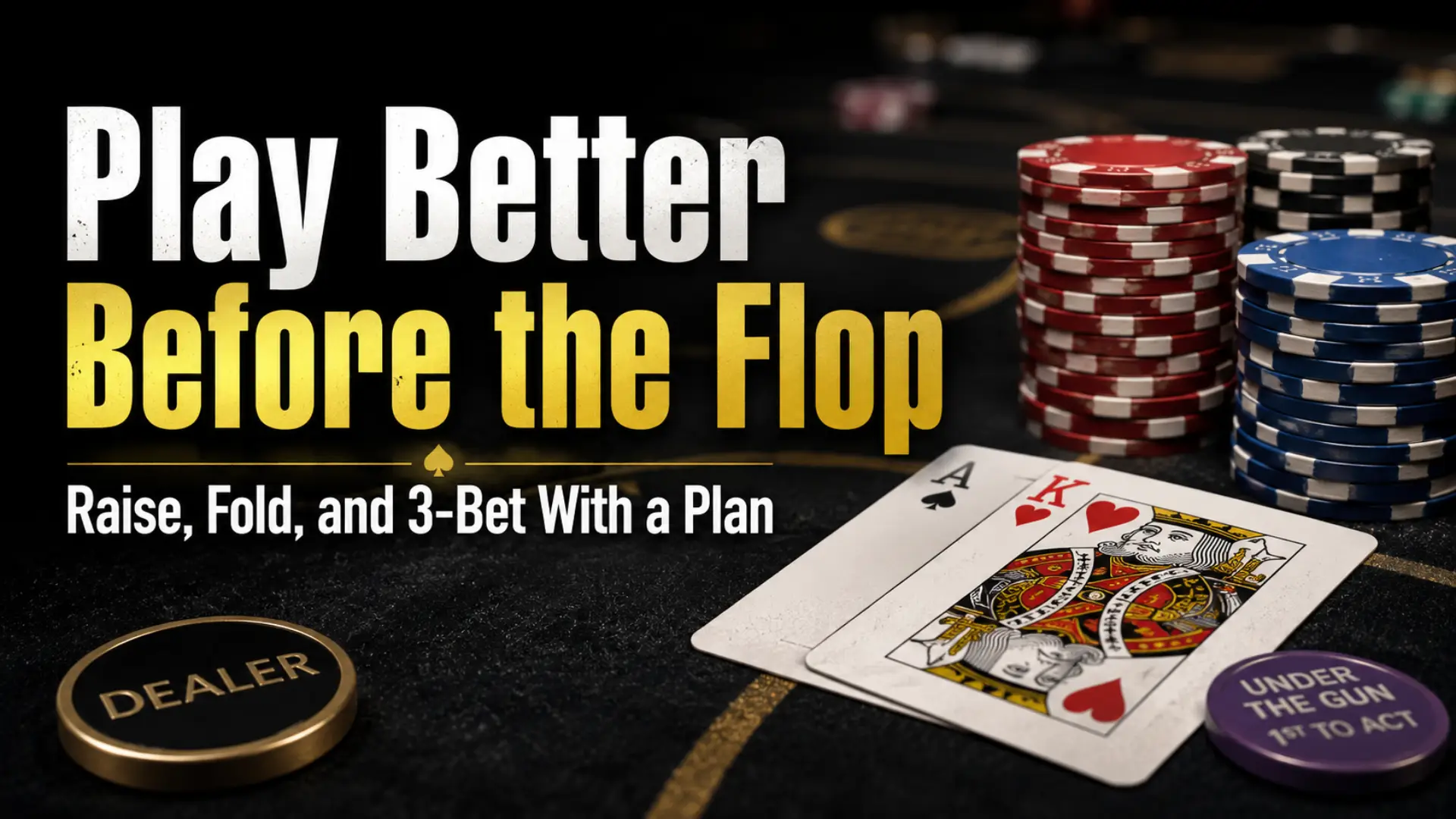
Pre-flop is every decision you make before the first three community cards are dealt. In Texas Hold’em, those decisions — raise, call, or fold — determine which pots you enter, how much you invest, and what range of hands your opponents can put you on. Getting pre-flop right is the fastest way to stop bleeding chips before the hand even starts.
Most poker losses do not happen because of one bad river bluff. They accumulate quietly through hundreds of pre-flop errors: limping with weak hands, calling raises out of position with marginal cards, open-raising too large or too small, and failing to adapt to the players at the table. Pre-flop mistakes compound across sessions in a way that post-flop mistakes rarely do, because they affect every single hand you play.
This guide covers the three pre-flop actions, how to size your opens, how to respond to raises, and the most common mistakes players make before the flop is even dealt.
The Three Pre-Flop Decisions
Every pre-flop situation reduces to three choices. Understanding when each is correct — and why — is the foundation of solid pre-flop play.
Open the pot with aggression
Raising forces opponents to make a decision before seeing the flop. It builds the pot when you have a strong hand, narrows the field, and gives you the initiative going into the flop. Open-raising is almost always preferred over limping when you are the first player to enter the pot.
Match the current bet
Calling is rarely the right first action when no one has entered the pot (limping is generally weak). It is correct when facing a raise with a hand that has good implied odds or is not strong enough to 3-bet, and you are in a good position to see the flop profitably.
Protect your chips
Folding is the most underrated pre-flop action. Every fold of a losing hand saves chips. Many players fold too rarely and pay repeatedly for the privilege of seeing flops they cannot profitably play.
Open-Raise Sizing
Open-raise sizing is not fixed — it should adapt to the game format, stakes, and table dynamics. That said, most modern games have settled around a narrow range that balances pot control with fold equity.
| Game Type | Typical Open Size | Reasoning |
|---|---|---|
| Online 6-max cash | 2–2.5BB | Smaller opens are standard in 6-max because blind defense is more frequent. Large opens get called or 3-bet efficiently by thinking opponents. |
| Online full ring | 2.5–3BB | Slightly larger to account for more players left to act and a tighter table dynamic. 3BB UTG is common in tighter player pools. |
| Live cash game | 3–4BB | Live players call wider and fold less, so slightly larger opens extract more value and fold out marginal hands more reliably. |
| Tournament (with antes) | 2–2.2BB | Antes create dead money in the pot, making smaller opens profitable. A 2BB open when antes add up to ~0.5BB effectively risks very little relative to the pot you win uncontested. |
| Button vs limpers | 3–4× limp amount | Isolating limpers rewards raising larger. You want to put pressure on weak hands and control the pot heads-up or with one caller if possible. |
Use the same open size for all hands in a given position. If you open larger with AA and smaller with AJo, observant opponents will start reading your sizing as a tell.
Facing a Raise: Call, 3-Bet, or Fold?
When another player has already raised before you act, your three options carry different strategic implications. The right choice depends on your hand, your position relative to the raiser, and the stack depths involved.
Re-raise for value or as a bluff
3-betting takes the initiative. For value, use your strongest hands (AA, KK, QQ, AKs, and sometimes JJ or AQs depending on position). As a bluff, use hands with good blockers and playability — suited aces, suited broadways, and strong connected hands. Keep your 3-bet range balanced.
See the flop with implied odds
Call when your hand is not strong enough to 3-bet for value but still profitable to play: pairs below JJ hoping to flop a set, suited connectors with deep stacks, and strong broadways in position. Calling in position against a single raiser is far better than calling out of position.
Protect your stack
Fold hands that are too weak to 3-bet and too weak or poorly positioned to call. This includes most offsuit non-aces from early position, weak kickers facing tight openers, and any hand you do not have a clear plan for post-flop.
3-Bet Sizing
The size of your 3-bet matters as much as the decision itself. Sizing too small invites the original raiser to call profitably with speculative hands. Sizing too large reduces your fold equity and bloats the pot unnecessarily.
| Situation | Suggested 3-Bet Size | Why |
|---|---|---|
| In position (CO, BTN) | ~3× the open | You have a positional advantage, so you need less size to extract value. A 2.5BB open 3-bet to ~7.5–8BB is standard. |
| Out of position (SB, BB) | ~3.5–4× the open | You act first post-flop, so you need a larger 3-bet to compensate. A 2.5BB open 3-bet to ~9–10BB from the blinds is typical. |
| Facing a limper + raiser (squeeze) | Add ~1BB per caller | Each caller in the pot reduces the chance everyone folds. Increase your squeeze size to compensate: e.g., one caller behind a 2.5BB open suggests a 3-bet to ~11–12BB. |
| Facing a 3-bet (4-betting) | ~2.2–2.5× the 3-bet | A 4-bet needs to deny the 3-bettor’s implied odds without over-committing. If they 3-bet to 9BB, a 4-bet of ~20–22BB is standard. |
Playing the Blinds
The blinds are the two forced positions that cost you chips every orbit. Playing them well separates players who slowly leak money from those who minimize the damage.
Small Blind
The small blind is the worst seat in poker over time. You are the second-most expensive position to play (behind the big blind in terms of total forced investment), but you act first post-flop in every round. Against an open raise from any position, your SB strategy is straightforward: mostly 3-bet or fold. Cold calling from the SB leaves you out of position and without initiative, a combination that costs money consistently.
Big Blind
The big blind defends more frequently because you are already invested in the pot and get a discounted price to see the flop. Against a single raise, your defense frequency should be high enough to prevent the button or cutoff from stealing profitably every orbit. Against a 2.5BB open, the big blind is getting roughly 1.5:4 odds, which means folding more than 37% of hands lets opponents steal profitably forever.
Five Common Pre-Flop Mistakes
- Limping in as the first player to act. Limping gives away position, initiative, and information. It signals weakness to every remaining player and invites aggressive 3-bets or cheap calls from speculative hands. If a hand is worth playing, it is usually worth raising.
- Using inconsistent open sizes for different hand strengths. Opening 3BB with strong hands and 2BB with weak ones is a readable tell. Pick a standard size for each position and use it with every hand you open.
- Flat-calling 3-bets with hands that should fold or 4-bet. Cold-calling a 3-bet out of position with JJ or AQ is a common mistake. Without a clear reason to call — deep stacks, strong position, or implied odds — most holdings should either 4-bet or fold when facing a 3-bet.
- Defending the big blind too wide or too narrow. Folding every marginal hand to a steal gives opponents a free pass. Calling every raise regardless of strength inflates your VPIP without increasing your win rate. Calibrate defense to price, position, and opponent tendency.
- Ignoring stack depth when 3-betting or 4-betting. Re-raising with a hand you cannot comfortably play for stacks is a structural error. If a 4-bet commits you to more than you are comfortable risking with that hand, either flat-call or fold. Accidentally committing stacks in unfavorable situations is one of the most expensive pre-flop mistakes.
Frequently Asked Questions
What does “pre-flop” mean in Texas Hold’em?
Pre-flop refers to the round of betting before any community cards are dealt. Each player receives two hole cards face-down, and then players act in order — posting blinds, folding, calling, or raising — before the first three community cards (the flop) appear.
Should I ever limp in Texas Hold’em?
Very rarely as the first player in. Limping occasionally with very strong hands (to vary your play) or with speculative hands after multiple other limpers can be acceptable. But as a general habit, especially at tighter tables, open-raising is almost always better. Limping forfeits initiative, inflates multiway pots, and makes your hand easier to read.
How big should my 3-bet be?
In position, roughly 3 times the original raise. Out of position, roughly 3.5 to 4 times. If there are callers between you and the original raiser, add about 1 big blind per caller. So if the button opens to 2.5BB and a player calls, a squeeze from the blinds would typically be around 11–13BB.
When should I 4-bet instead of calling a 3-bet?
4-bet with your strongest hands (AA, KK, and sometimes QQ or AK depending on position) and with a small number of well-chosen bluffs — typically hands with good blockers to premium holdings, like AJo, A5s, or KQs. Flat-calling a 3-bet out of position with a hand like QQ can be profitable in deep-stack spots but is generally a losing play for most stack depths.
How often should I defend my big blind?
It depends on the open size and who is raising. Against a 2BB open, you should defend a very wide range — perhaps 50–60% of hands — because the price is too good to fold frequently. Against a 3BB open from an early-position tight raiser, you can fold more than half of your hands without giving up too much. The exact frequency matters less than the principle: defend enough that your opponents cannot open-raise profitably every time you are in the big blind.
What is a squeeze play?
A squeeze is a 3-bet made after one player has raised and at least one other has called. The original raiser faces a raise from behind, and the caller is “squeezed” between the two — if they call, they risk facing the original raiser still behind them. Squeezes work well with strong hands and as bluffs using hands that block the caller’s likely range.
Looking for the right platform to practice?
PokerOffer compares trusted online poker platforms so you can find the right game type, stake level, and bonus offer before you sit down.
This guide is for educational purposes only. Online poker involves financial risk and is intended for adults aged 18 and over. Please play responsibly and follow the laws in your location.