The board is K♥ J♥ 8♥ 5♥ 2♣. Your Omaha hand is A♥ A♣ Q♦ 9♣.
If A♥ A♣ were your hole cards in Texas Hold’em, you would have an ace-high flush. In Omaha, you have only a pair of aces.
The hand rankings have not changed. The rule has: Omaha requires you to use exactly two hole cards and exactly three community cards. With only one heart among your four hole cards, you cannot make a flush.
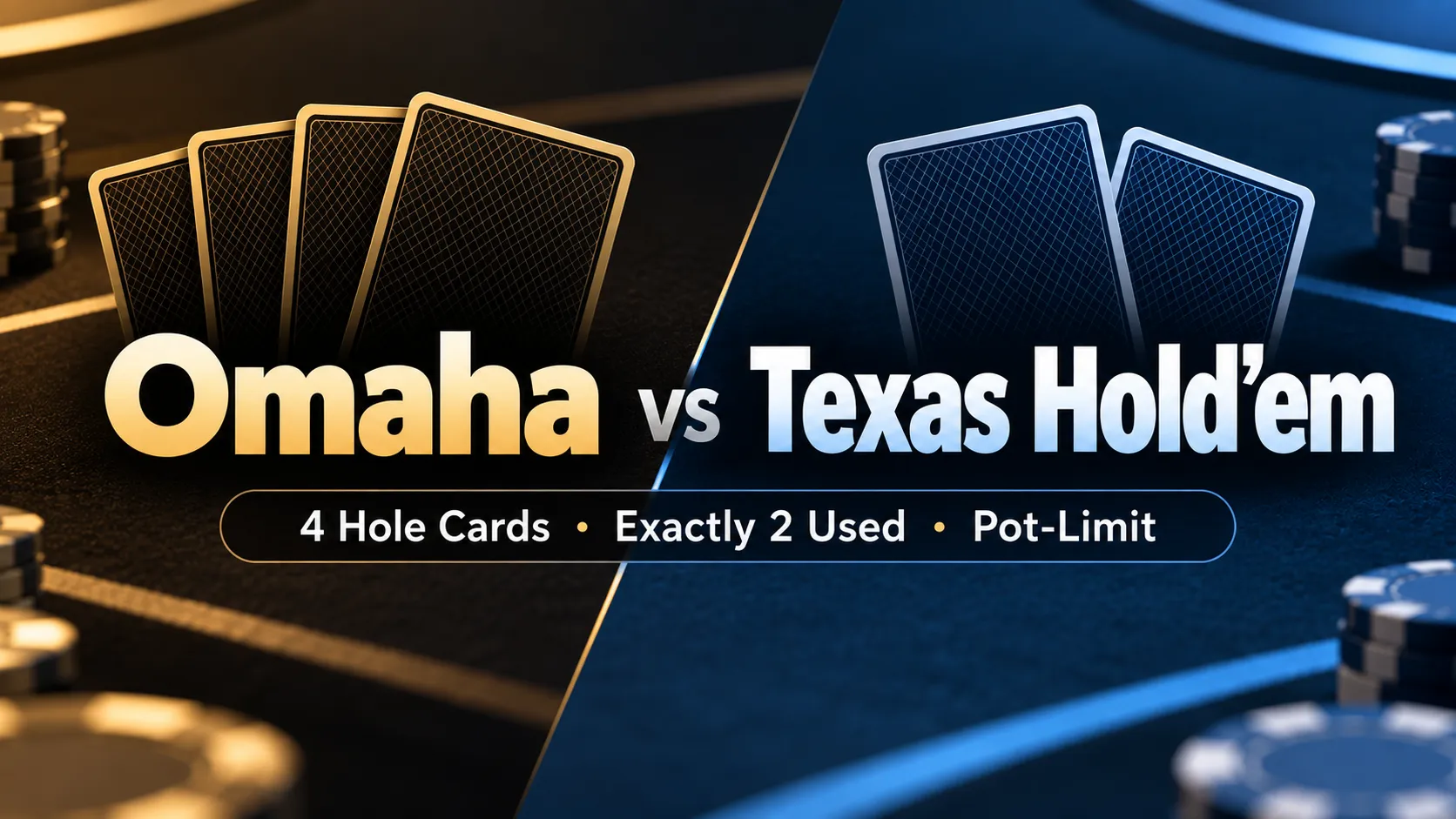
Hold’em experience still helps in Omaha, but four hole cards and the exactly-two rule change how you read even familiar boards. Pot-Limit betting adds another difference once the chips start going in.
This guide compares No-Limit Texas Hold’em with four-card Pot-Limit Omaha high, commonly called PLO.
Omaha vs Texas Hold’em at a Glance
| Texas Hold’em | Pot-Limit Omaha | |
|---|---|---|
| Hole cards | 2 | 4 |
| Community cards | 5 | 5 |
| Hole cards used in the final hand | 0, 1 or 2 | Exactly 2 |
| Community cards used | 3, 4 or 5 | Exactly 3 |
| Common betting format | No-Limit | Pot-Limit |
| Starting-hand combinations | 1,326 | 270,725 |
A 52-card deck produces 1,326 possible two-card combinations and 270,725 possible four-card combinations.
That does not mean PLO has 270,725 strategically distinct starting hands. It shows how quickly the number of possible holdings expands when every player receives two additional cards.
Four Hole Cards Create Six Possible Pairings
A four-card Omaha hand contains six different two-card combinations.
Take A♠ K♠ Q♥ J♥. Its possible pairs are A-K, A-Q, A-J, K-Q, K-J and Q-J. Depending on the flop, several of those combinations can contribute to straights, flushes, pairs or draws.
Now compare it with A♠ K♠ 7♦ 2♣.
Both hands contain A-K suited. In the first hand, all four Broadway cards work together. In the second, the 7 and 2 contribute much less to most boards that favour the A-K portion of the hand.
A strong-looking Hold’em pair inside a four-card holding tells you surprisingly little about the quality of the entire PLO hand. The other two cards still affect which flops you connect with, which draws you can make and whether your strongest completed hands are likely to be the nuts.
Pairs, high cards, connectivity and suitedness all matter more when they complement one another.
Double-suited A-A-K-K is an obvious example. It combines pocket aces, another premium pair, Broadway connectivity and two suits capable of making the nut flush.
Omaha Always Uses Exactly Two Hole Cards
Return to the opening board:
Board: K♥ J♥ 8♥ 5♥ 2♣
Hand: A♥ A♣ Q♦ 9♣
Hold’em would allow A♥ to join K♥ J♥ 8♥ 5♥ for an ace-high flush.
PLO does not. You must choose two cards from A♥ A♣ Q♦ 9♣ and exactly three cards from the board. Since no two hole cards are hearts, a flush is impossible.
Suppose instead you are dealt:
A♠ A♥ A♦ K♣
Three aces in your hole cards do not give you three of a kind. Because Omaha uses exactly two hole cards, the hand is still only a pair of aces pre-flop.
The third ace also removes one of the aces that could otherwise appear on the board.
Suit distribution can create a similar problem. Holding three cards of the same suit may look attractive, but the third suited card cannot join your final hand and is also no longer available to come on the board.
In PLO, identifying which two hole cards actually play needs to become automatic.
Why the Same Made Hand Can Mean Something Different
Four hole cards give every player more ways to interact with a coordinated board.
A single PLO holding can contain a made hand, a flush draw and several straight possibilities at the same time. Opponents can arrive at the same board with similarly dense combinations of made hands and draws.
So “I have a straight” is often only the beginning of the calculation.
A low flush is still a flush, but higher flushes are more relevant when ranges contain more suited combinations. A straight can be ahead while remaining vulnerable to a higher straight or a redraw. Even a very strong made hand can face a draw with substantial equity.
You need to know which stronger hands are available, which draws fit the action and how the next community card changes the board.
Pre-Flop Equity Gaps Are Often Narrower
Pocket aces can hold a very large pre-flop equity advantage over many Texas Hold’em hands.
The gaps are generally smaller in PLO because four-card holdings have more ways to improve. Even a weaker hand can connect with the board through several different two-card combinations.
Pocket aces remain premium. They simply do not hold the same type of overwhelming pre-flop advantage against many playable PLO hands that A-A can have in some Hold’em matchups.
That does not make four random cards worth playing.
Poorly coordinated hands frequently make expensive second-best holdings. A non-nut flush can run into the nut flush. Low connected cards can complete a straight below the highest available straight. Weak side cards can leave A-A with few useful ways to improve when the flop becomes heavily coordinated.
With smaller pre-flop edges, coordination and nut potential become central to starting-hand selection.
Nut Potential Matters More
Suppose two players are drawing to a flush.
One can make the ace-high flush. The other can make only the king-high flush.
Both may complete their draws on the same card, but only one makes the nut flush.
This is why nuttiness, the ability to make the best possible hand, carries so much weight in PLO.
The same concern applies to straights. Some connected hands make straights frequently but often toward the lower end of the possible straight range. Higher connected cards can reach the nut straight on more boards.
Strong non-nut hands remain playable, and position, ranges, stack depth, board texture and bet size still matter. PLO simply produces more situations where an apparently strong hand is second best.
Combo Draws Can Challenge Made Hands
PLO draws are often built from several pieces at once.
A player might hold an open-ended straight draw, a flush draw, additional straight outs and a pair within the same four-card hand. These are commonly called combo draws.
Some carry enough equity to compete closely with a made hand that is currently ahead.
Two players can also hold the same straight while having very different prospects on the remaining cards.
If one of them also has a flush draw or cards that can improve to a higher straight, the hands may be tied now but no longer have identical equity across the possible turn and river cards.
These additional ways to improve are redraws, and they are a major part of post-flop hand strength in PLO.
Pocket Aces Are Strong, but the Side Cards Matter
Compare these two PLO hands:
A♠ A♥ K♠ K♥
A♠ A♥ 7♦ 2♣
Both contain pocket aces. Their post-flop prospects are very different.
A♠ A♥ K♠ K♥ has another premium pair, two nut-flush suits and connected high cards. A♠ A♥ 7♦ 2♣ relies much more heavily on its aces and produces fewer strong combinations across different flops.
Side cards matter with K-K as well. Kings accompanied by connected, suited cards offer more useful possibilities than K-K with two disconnected low cards.
Hands such as J-T-9-8 show the other side of PLO starting-hand construction. There is no premium pocket pair, but the cards work together across many straight combinations and draws.
The strongest-looking two cards do not define the whole hand.
Pot-Limit Changes How Betting Pressure Builds
No-Limit Hold’em does not cap the maximum bet at the size of the pot; a player can wager up to their remaining stack.
PLO uses Pot-Limit betting, so the maximum bet or raise is tied to the size of the pot.
With $80 in the pot and no existing bet, the maximum bet is $80.
Raises require the amount needed to call to be included in the calculation. If an $80 pot faces a $40 bet, the next player can raise to a maximum of $200 total.
Calling the $40 would first bring the pot to $160. The player may then raise by that $160 pot amount, making the total wager $200.
With $80 in an unopened pot, you cannot simply bet $500. Repeated pot-sized betting can still build a very large pot within a few actions.
NLHE can apply immediate pressure through unrestricted maximum sizing. In PLO, earlier bets determine how large later bets are allowed to become.
Bluffing Still Has a Place in PLO
More hole cards give players more ways to connect with the board, so good PLO bluffs often rely on more than simply having a weak hand and choosing a large bet.
Blockers can matter.
Imagine a board with three spades while you hold A♠ but no second spade. You cannot have a flush because PLO requires two suited hole cards. Your opponent, however, cannot hold A♠, which removes any nut flush containing that card from their possible holdings.
The ace gives you information about the strongest flush combinations your opponent can have even though it does not complete your own hand.
A blocker alone is not enough to justify a bluff. Whether betting makes sense still depends on ranges, position, sizing, previous action and the rest of your hand.
What Should a Hold’em Player Learn First?
Position, pot odds, ranges, value betting and bluffing all carry over from Hold’em. The betting rounds are familiar too.
The first PLO adjustments are more specific.
Learn to construct every hand with exactly two hole cards and three board cards. Evaluate all four starting cards instead of isolating the strongest-looking pair. Pay closer attention to nut potential, dominated draws and redraws. When comparing pre-flop hands, expect fewer of the extreme equity gaps that appear in some Hold’em matchups.
Once the exactly-two rule becomes automatic and you start evaluating all four hole cards together, the rest of PLO strategy becomes much easier to build on.