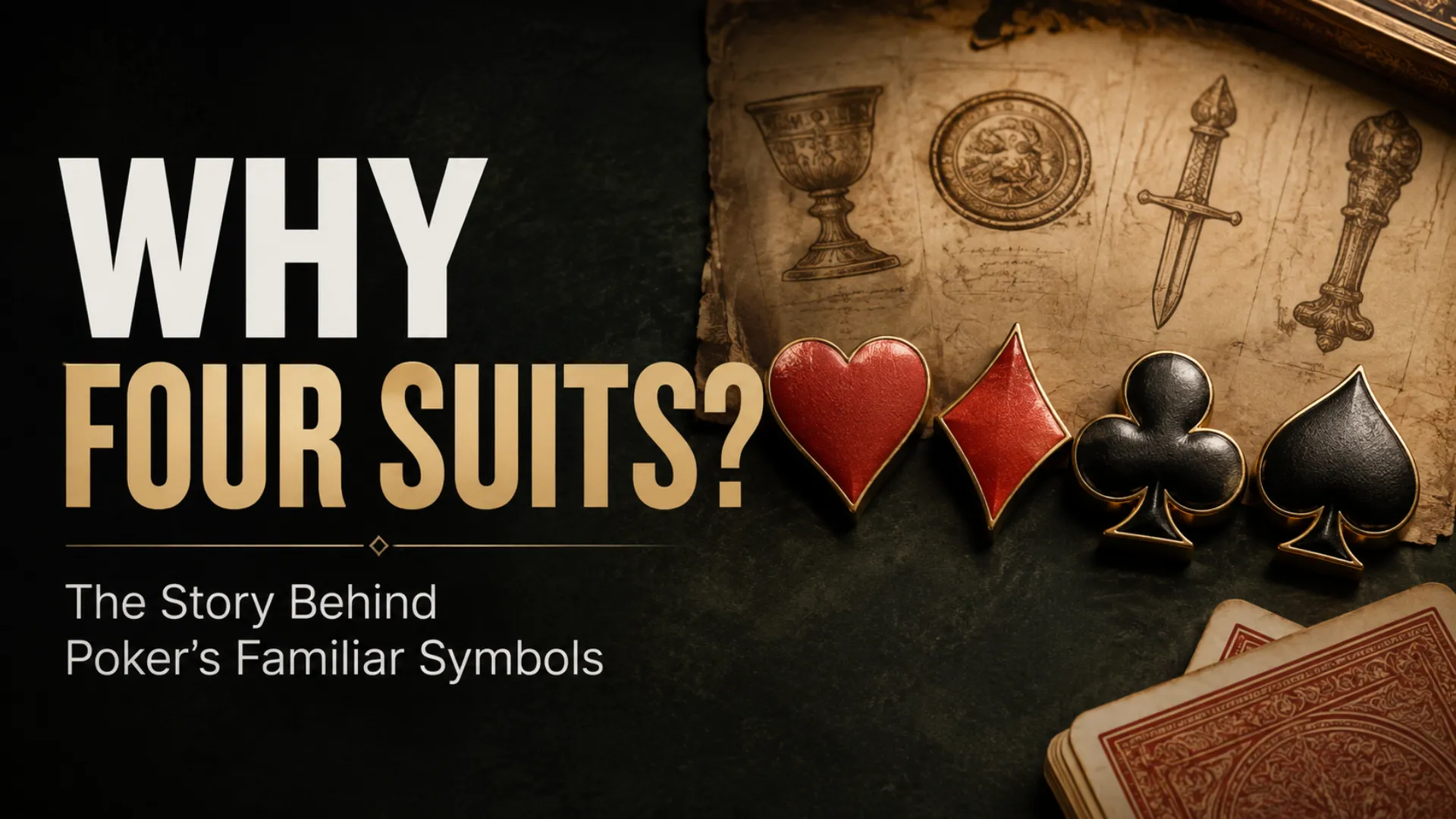
Hearts, diamonds, clubs and spades are so familiar that it is easy to assume they have always belonged to poker. They haven't.
The four symbols were not created for poker at all. They emerged from centuries of playing-card development, during a period when European decks could feature everything from cups and swords to bells, acorns, animals and even hunting equipment.
So how did these four particular suits survive to become the standard—and does a spade actually outrank a heart at the poker table?
Poker's Four Suits Are Older Than Poker
Poker inherited its four suits from the standard playing-card deck, which means their story begins centuries before the development of modern poker.
Playing cards begin appearing in European records in the 1370s, with references emerging in several parts of the continent within a relatively short period.
One of the strongest clues to their earlier development comes from cards associated with Mamluk Egypt. Known Mamluk examples use four suits: cups, coins, swords and polo sticks. That structure closely resembles the Latin-suited cards that later became established in southern Europe.
The precise route by which playing cards reached Europe is not completely documented. Rather than a single confirmed moment of invention, the surviving evidence points to a longer process of transmission and adaptation around the Mediterranean.
Before Hearts and Spades Came Cups and Swords
As playing cards became established in Europe, different regions developed their own suit systems.
Italian and Spanish traditions became associated with what are now known as Latin suits:
- Cups
- Coins
- Swords
- Batons or clubs
These were not simply older versions of hearts and spades. They belonged to separate regional playing-card traditions, some of which still survive in traditional decks today.
More importantly, Europe did not have one standard deck. Suit symbols, deck structures and designs could vary considerably from one region to another.
Some Early Card Suits Look Nothing Like Today's Deck
Playing-card design was far from standardized in 15th-century Europe.
The Stuttgart Playing Cards, made in Germany around 1430, provide a striking example. Instead of the four suits familiar to poker players today, their suits are Falcons, Ducks, Hounds and Stags.
Another surviving deck is even more unusual.
The Cloisters Playing Cards, dated to around 1475–1480 and now held by The Metropolitan Museum of Art, use four suits based on hunting equipment: Horns, Collars, Tethers and Nooses.
To a modern poker player, these can look more like themed decks than ancestors of everyday playing cards. At the time, however, there was nothing inevitable about clubs, diamonds, hearts and spades.
Surviving decks like these show just how varied Europe's playing-card landscape once was. The modern four suits did not simply replace one earlier standard; they emerged from a period in which numerous designs and regional systems coexisted.
How the French Suits Became the Familiar Four
During the 15th century, French card makers adopted the four suit signs that would eventually become familiar around the world: hearts, diamonds, clubs and spades.
One important advantage of the French system was practical.
Many earlier suit signs involved more detailed images that had to be reproduced repeatedly. French suit symbols were simpler shapes that could be applied efficiently with stencils, making number cards easier to manufacture. The system also developed the familiar two-color arrangement of red hearts and diamonds alongside black clubs and spades.
That production advantage helped French-suited cards spread, although it should not be treated as the only reason for their success.
French cards were later exported to England, including decks produced in places such as Rouen. The English tradition that developed from them eventually became the basis of the Anglo-American deck now widely used for poker.
The symbols sitting in the corners of modern hole cards are therefore the result of a much longer playing-card history—not something poker itself invented.
Do the Four Suits Represent Medieval Social Classes?
A popular story gives the four French suits a social meaning.
One version links hearts with the clergy, diamonds with merchants, clubs with peasants and spades with the nobility or military class.
It is an appealing explanation, but it should not be treated as established history.
Playing-card suits have attracted many symbolic interpretations over the centuries, and there is not enough evidence to show that this four-class theory was the original intention of the French card makers who adopted the symbols.
It is better understood as a popular interpretation than a confirmed explanation for the origins of the four suits.
Do Poker Suits Have a Ranking?
No—not when determining the winning hand.
Standard poker does recognize the following suit order for certain special purposes:
Spades > Hearts > Diamonds > Clubs
But that does not make a spade flush stronger than a heart flush.
At showdown, suits are equal. Poker hands are compared by their hand category and the ranks of the cards involved, not by whether the cards are spades, hearts, diamonds or clubs.
If two players in Texas Hold'em have exactly the same best five-card hand, the pot is split. A spade does not break the tie.
The same principle applies to equivalent straight flushes or royal flushes: one suit is not inherently stronger than another under standard poker hand-ranking rules.
Calling spades the "highest suit in poker" without that context is therefore misleading.
When Does Suit Order Matter in Poker?
Although suits do not decide the winning hand, some poker rules use suit order to resolve procedural ties.
Depending on the game and the rules in use, the conventional Spades–Hearts–Diamonds–Clubs order may be used when:
- drawing cards to assign seats or determine an initial dealer;
- breaking a tie between exposed cards when determining action or a bring-in in stud poker;
- awarding an odd chip that cannot be divided evenly in certain split-pot situations.
These are administrative or procedural decisions. They do not change the value of the poker hand itself.
The simplest rule to remember is:
A poker hand does not become stronger because of its suit. Suit order matters only when a specific rule calls for it.
House rules can differ, so players should always confirm the rules being used in a private or unfamiliar game.
Four Symbols With Centuries of History
Hearts, diamonds, clubs and spades may look like one of the simplest parts of a deck, but they are the survivors of a much more varied playing-card history.
European decks once featured cups, swords, bells, acorns, birds, animals and even hunting equipment. Over time, the simpler French suit system spread beyond France and became the foundation of the standard deck used in most poker games today.
And one common poker myth disappears once that history is separated from the rules: spades may rank first for a few procedural purposes, but at showdown, a spade does not make your hand any stronger.